Home / Blog / Moved Down in Google? The Rules Have Changed
Has Google ranked you lower? The rules of the game have changed
Your ranking hasn’t dropped – Google’s AI layer now filters differently. We’ll show you what’s changed, why clicks are down, and how you can still feature in answers.
You’ll see a lot of places reporting that Google's AI changes have caused businesses that used to be on page one to “drop down the rankings”. The worry is understandable — but the reality is more nuanced (and actionable). Let’s look at what the actual data says, and more importantly: what you can actually do to turn this to your site’s advantage. We’re not here for scare tactics, but for what you can really influence.
What’s Actually Changed: Not Rank, but Clicks
The most common misunderstanding is “Google ranked me lower”. Most of the data out there doesn’t show a drop in rankings, but in clicks: the AI-powered ‘Overview’ is now shown above classic results, and often answers the user’s question right there, with no click needed.
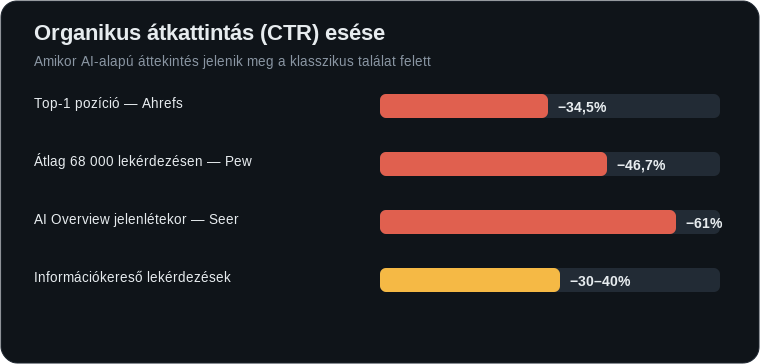
While the exact numbers vary between sources, the trend is clear: Pew Research measured a 46.7% relative drop in clicks across 68,000 queries; Ahrefs saw a 34.5% drop for the top-1 spot; and Seer Interactive recorded up to 61% when AI Overviews appear. In other words: the same ranking today brings fewer clicks than a year ago — your position might not have changed at all.
Rankings No Longer Predict Citations
There’s a deeper change too. Previously, if you got into the top 10, you had a good chance of being cited in the featured snippet. That link is now broken:
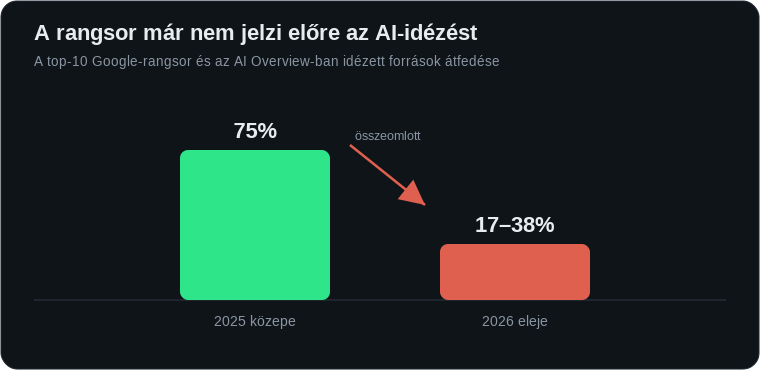
The overlap between top-10 organic search results and sources cited in AI Overviews dropped from around 75% in mid-2025 to just 17–38% by early 2026. Many experience this as a “decline”: their old ranking is intact, but now they're not chosen for the AI answers. Ranking and citation are now two separate games.
Who This Affects — and Who It Doesn’t (Here’s the Good News)
Here’s the biggest misconception: not everyone is affected equally, and some aren’t losers at all. The impact heavily depends on the type of query.
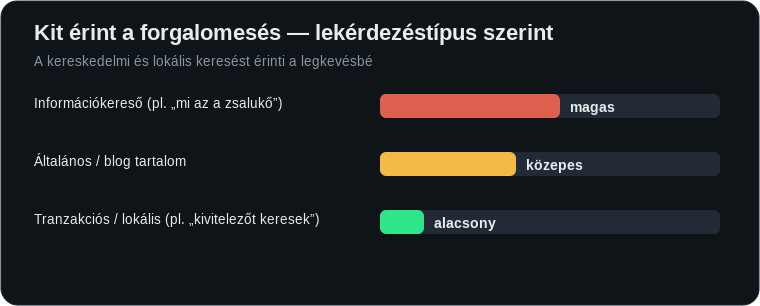
- Informational content (like “what is a zsalukő”) is hit the hardest — traffic losses of 30-40% are common, because the AI gives ready-made answers to these questions.
- Transactional and local searches (like “looking for a zsalukő fence builder”) are affected the least — here, the user wants to get in touch, not just read a summary.
Two important points for context: around 58% of Google searches already end with no click (in AI Mode it’s about 93%) — but surveys show 63% of companies say AI Overview actually boosted their visibility, because now even sites in 11th–20th position can get cited by the AI. “Everyone’s lost out” is simply not true.
And a word of caution: the most dramatic stats often come from SEO agencies with a business interest in scaremongering. Reliable, independent figures (Pew, Ahrefs, Seer) also show a significant, but nuanced impact — not a universal collapse.
What You Can Influence: From Clicks to Citation
The real story isn’t “page one is over”, but that the game now is about citation, not clicks. And that’s good news — because citation depends on clear, measurable, and influenceable factors:
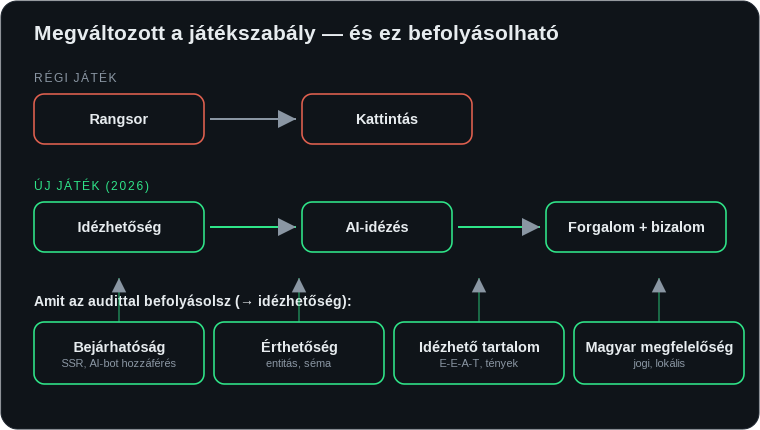
AI selects sites as sources if your site is:
- crawlable — leading AI crawlers don’t run JavaScript and can’t be blocked by firewalls (so you need SSR and AI bot access);
- understandable — with clear entity and schema signals, so the machine knows who you are and what you do;
- citable — providing specific, factual, first-hand content (E-E-A-T), not vague generalities;
- suitable for Hungary — legal and local signals aligned to Hungarian search intent.
These are exactly the four areas the AI Visibility Audit measures — and this isn’t theory. In the keritesed.hu case study the same optimisations turned the site into a recommended builder in ChatGPT as well as a Google page-one result; our own site’s case study shows how fast a technically clean site can be indexed and ranked.
How Much Can We Really Influence? — Honestly
Not everything. AI answers are volatile, competition is tough, and you can’t guarantee citation with a single tweak. But the factors you can influence are exactly the ones that matter most: crawlability, clarity, citability, and legal/local fit. The audit gives concrete, prioritised steps for these — and the better your basics, the bigger your chance of being cited by Google AI and ChatGPT.
You’re actually in a strong position: searches related to construction, fencing, tiling, or demolition are typically transactional/local — precisely the type least affected by this wave, and where citable content turns to profit fastest.
Summary
It’s not your ranking that dropped — the rules changed: citation, not clicks, is now the key. “Everyone dropped down” is a big oversimplification; in reality, old rankings are less valuable, while citation is a new competition you can win. And it’s this one investment that pays off both with Google AI and ChatGPT — because in 2026, both use the same basic signals.
Curious where you stand on citability now? Start a free audit — it only takes a few minutes and you’ll receive your four section scores plus a prioritised to-do list.
Curious how your own site performs in AI search engines?
Free AI Visibility Audit →