Home / Blog / Does ChatGPT Recommend You? The Measurement Methodology
Does ChatGPT Recommend You? The Measurement Methodology
Rank tracking doesn’t work for AI responses. We present the prompt-monitoring methodology: weekly measurement, stability filtering, competitor comparison, and reporting.
In short: visibility in AI responses is measurable — but not in the same way you've measured your Google ranking so far. There’s no 'Search Console' for this, responses change daily and per user, and most recommendations happen without clicks. That’s why we built our own measurement system: we run a prompt-library of real customer questions weekly using the official APIs of ChatGPT and Gemini — and instead of a single snapshot, we measure presence ratio. We summarise the results in a monthly report. This article explains our methodology, the metrics, and the automation — based on our own real data.
How can you check if your company appears in the answers of ChatGPT or Gemini?
There are three ways: manual testing (quick, but misleading since AI answers change each run), official reports (today only available for Bing/Copilot), and repeated, synthetic measurement — this last one is what we do, as it's the only way to get a reliable picture. The next section explains why simply entering your question into ChatGPT once is not enough.
Why doesn’t traditional measurement work for AI answers?
Classic SEO measurement relies on three pillars: ranking position, impressions, and clicks. In the world of AI assistants, all three become shaky:
- No stable 'position'. The same question might get five company recommendations from ChatGPT today and four tomorrow — in different order. The answer isn’t deterministic: if someone tries to say 'your rank in ChatGPT' using just one screenshot, all they're measuring is variance, not visibility.
- Most recommendations are without clicks. The user sees your company name in the answer, might then Google your brand or call you, but classic traffic data doesn’t show this (or only very indirectly). We covered this in detail in our What is AI Traffic? article.
- Few official measurement tools. Google Search Console doesn’t have a full-featured AI equivalent on every platform — the measurement landscape is fragmented and varies by platform.
What can be officially measured today — the measurement map
Before we move to our own methodology, let’s note what is available 'out of the box':
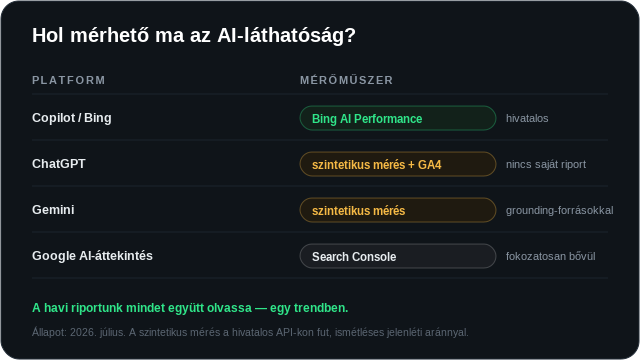
- Bing / Copilot: Bing Webmaster Tools’ AI Performance report provides first-party citation data — it shows how many AI responses cited your site, with which internal search queries (grounding queries), and your Citation Share compared to other cited sources. This is currently the most advanced official AI visibility report (Bing Webmaster Tools).
- ChatGPT: OpenAI offers no webmaster report. Officially, there are two things: allowing bot access (the OAI-SearchBot decides if ChatGPT may cite your site — OpenAI bot documentation), and click measurement via analytics (GA4, chatgpt.com as source). However, these don’t show mentions.
- Google AI Overview: According to Google's official guide, the gateway is being indexed and snippet-eligible (Google AI optimisation guide); reports for the generative surfaces in Search Console are appearing gradually.
- International tools: The missing ChatGPT measurement is provided by paid platforms (synthetic prompt runs) — usually packages priced in the $140–500+ range per month, for the English-speaking market.
The takeaway: the Copilot side can be measured officially, ChatGPT/Gemini only synthetically. That’s exactly the gap our methodology fills — in Hungarian, for the Hungarian market.
Our methodology in five steps
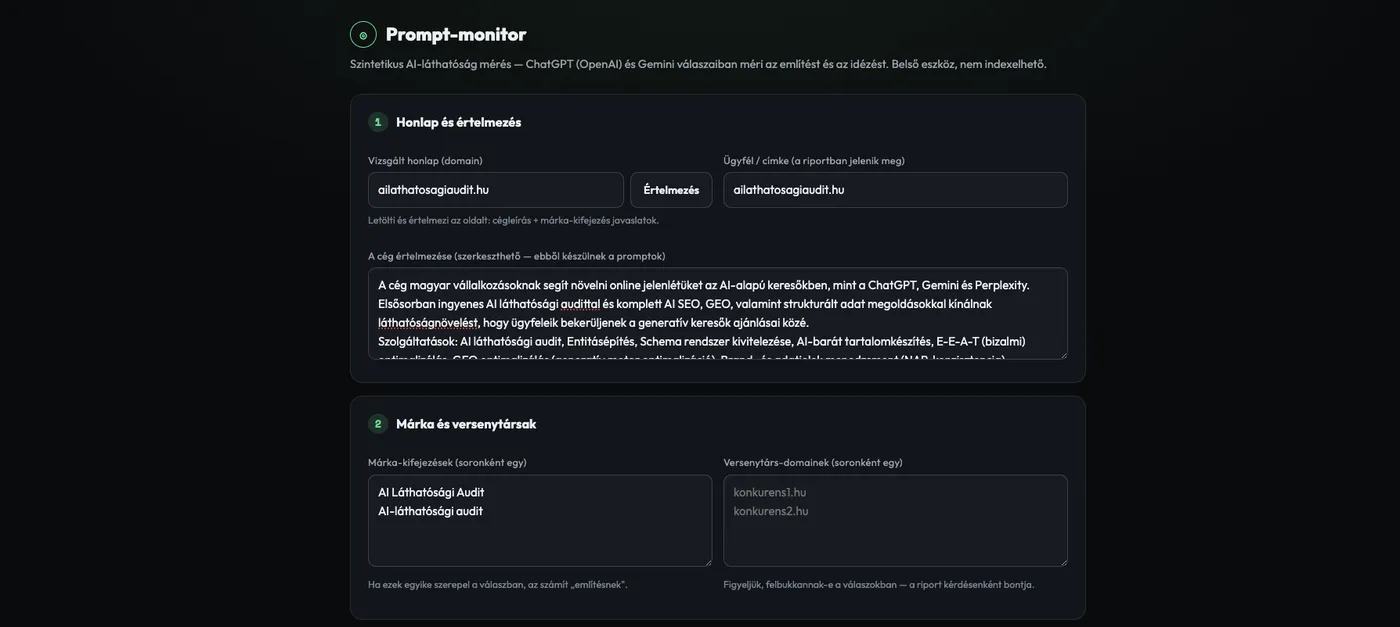
1. Prompt library: your customers’ real questions
We don’t measure keywords, but rather questions — the ones real potential clients ask the AI. We group questions into five categories, because each one measures something different:
- brand — questions mentioning your name (e.g. 'Is ... trustworthy?'): measures your reputation;
- recommendation — 'Who do you recommend / who can do / who should I go to?': the category that leads to actual business;
- price — 'How much does ... cost?': the last step before buying;
- fundamentals — informative, pre-decision questions: this is where the customer discovers who is an expert;
- service — asking about specific services.
We work with 40–50 questions per client, and the library is dynamic: it grows with new question types as they appear on AI platforms.
2. Synthetic runs on the official APIs — weekly
Questions are run on the OpenAI model powering ChatGPT (with web search, Hungarian location) and Gemini (using Google Search grounding) — that is, the same systems your potential customers use. Measurement is weekly — meaning model updates and competitor changes show up without weeks of lag. We extract two things automatically from each answer: the text (does it mention the brand) and the list of cited sources (does it contain the domain).
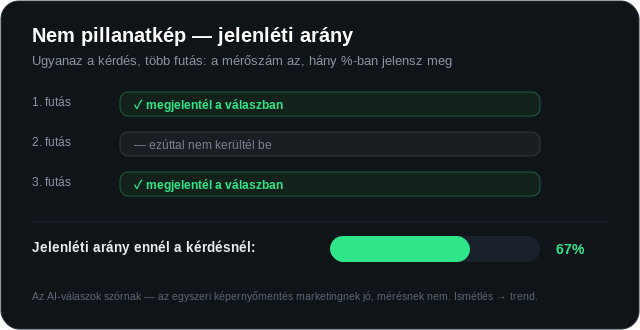
3. Repetition: presence ratio, not just yes/no
Since responses vary, each question is run multiple times, and the key metric is presence ratio: the percentage of runs in which you appeared. This is a 'share of model' approach: we’re not asking 'are you in?', but rather 'how likely is the buyer to find you?'. Think statistics, not just a single screenshot.
4. Mention and citation — two separate metrics
The two numbers mean different things, and we intentionally measure them separately:
- Mention rate: your company’s name appears in the answer text. This is visibility — the customer sees you.
- Citation rate: your website appears among the listed sources. This is authority — the AI builds on you as a source.
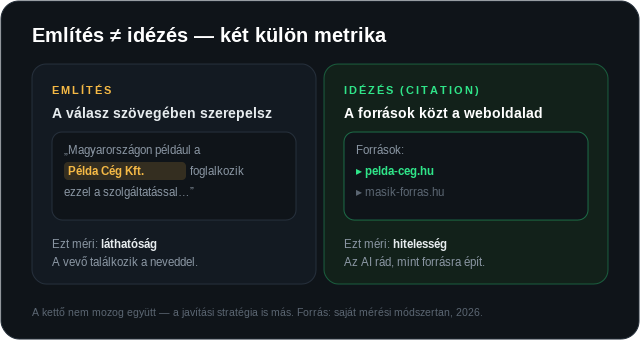
The two typically move independently: you might be mentioned but not cited as a source — or vice versa. The improvement strategy is different in each case (how does AI cite?).
5. Competitor breakdown per question
In the same results, we also record which competitors appear, and for exactly which questions. This guides your monthly work: it’s not just a vague “we need to improve”, but we know who owns the “how much does X cost” question and with what — so we can target content, sources, or entity signals there.
Automation
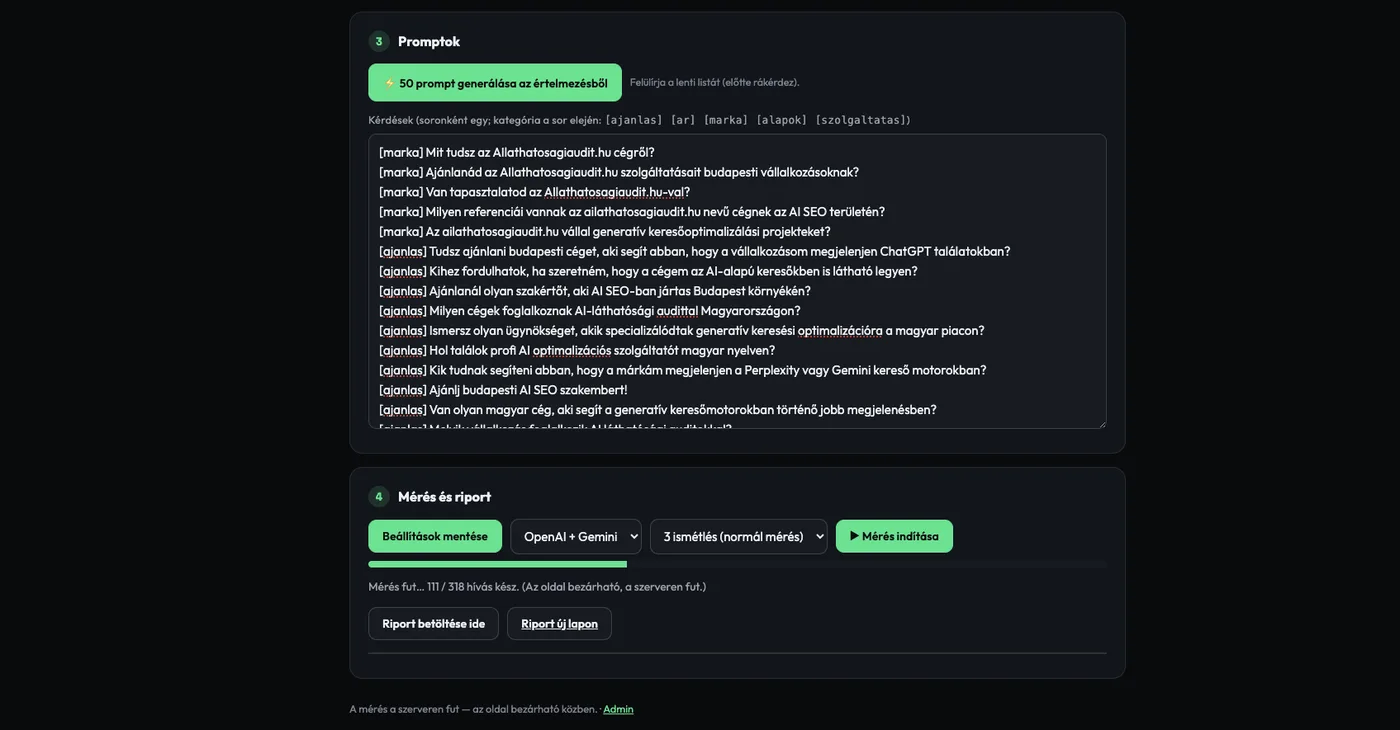
The process is automated: weekly scheduled runs, timing adjusted to platform quotas, automatic retries on errors, and every run recorded to a database. This means reports are always fresh: ratios of mentions and citations per platform, breakdown by category and question, competitor tables, and an error log. So the measurement isn’t just “someone looking at ChatGPT”, but reproducible data — and monthly reports are created from the weekly runs, so trends can be compared month by month.
What did our first in-house measurement show?
We first ran the system on ourselves. Here’s what the report looks like — real, unvarnished numbers:
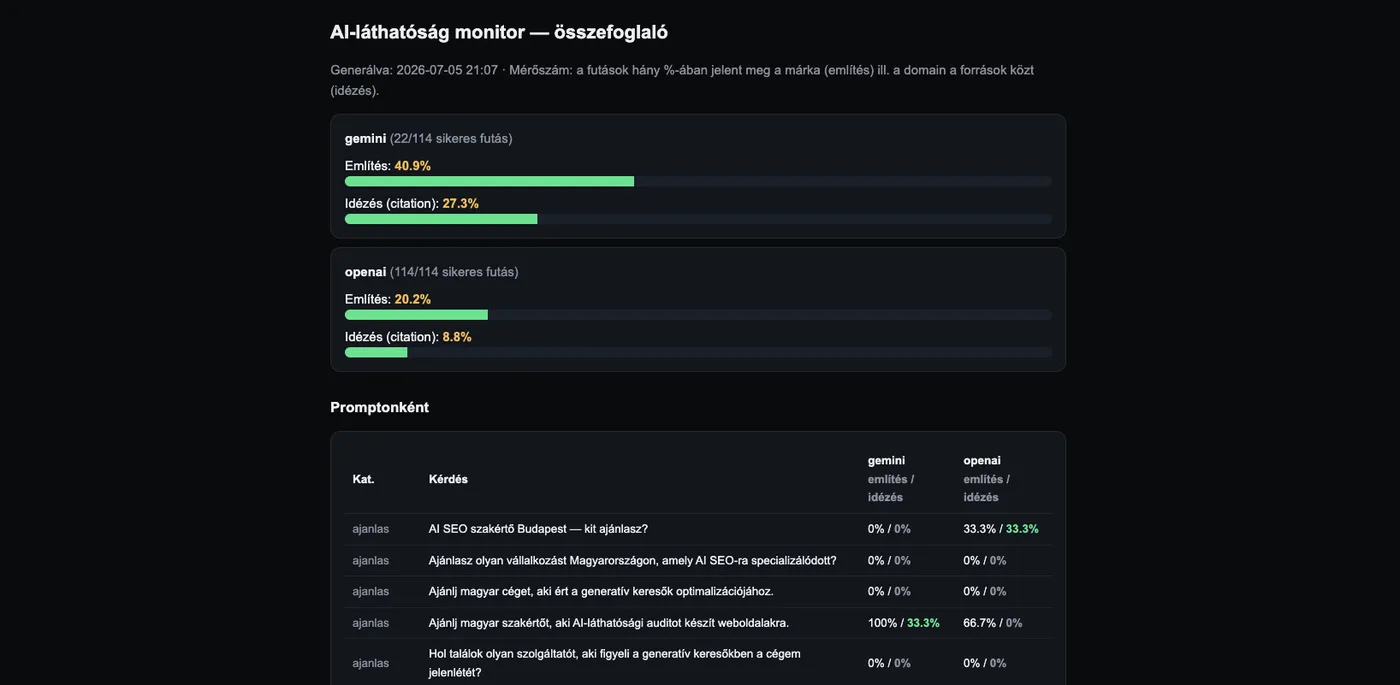
A few takeaways from the first round:
- For brand queries (like “what is ailathatosagiaudit.hu”, “is ... trustworthy”), the mention rate was 100% for most questions — when people ask specifically about us by name, the AI responds consistently, accurately, and positively.
- We also appeared in several high-value queries: for example, on questions such as “AI Visibility Audit price in Budapest”, we achieved 100% mention AND citation rates.
- The biggest lesson is the basics category: for informational queries (“what is GEO”, “how do I measure AI visibility”), our rate was nearly 0% — at the moment, other sources are referenced for these answers. That’s not a failure but a roadmap: we can see exactly which questions need buildable, citable content with reliable sources.
- Competitor breakdown identified three local players in the answers — we see at question level who is strong where, and this forms the to-do list for the following month.
This is the essence of the measurement: it’s not a leaderboard but a task list.
Honest limitations — you should know this too
We tell all our clients about three key limitations, since without them the numbers could be misleading:
- The API response is close to, but not always identical to what a consumer app returns (there are different system settings, and no personalisation). The measurement is therefore for trends and comparison — it's accurate for tracking if your presence grows and who overtakes you, but not for “every user sees exactly this”.
- Responses can vary — so we repeat measurements and track ratios. A single screenshot is good for marketing, but not for measurement.
- The snapshot is fragmented by platform — so we interpret synthetic measurement alongside official data sources: Bing AI Performance (Copilot page), GA4 AI traffic, and brand name search trends.
How do you get this as part of the monthly package?
Prompt monitoring is included in the monthly AI management package (€199–€369/month), and your month breaks down like this:
- Setup: based on interpreting your website, we assemble a prompt library of 40–50 questions and select the competitors to monitor — all agreed with you in advance.
- Weekly measurement: automated runs on ChatGPT and Gemini, with repetitions.
- Monthly report: trends of mention and citation rates, category and question breakdowns, competitor movement, plus data from Bing AI Performance and GA4 AI traffic.
- Action list: the report produces a concrete, prioritised task list — which questions need what content, source, or entity signal, and we handle these as part of the package.
Entry still starts with the free AI Visibility Audit: this shows whether you can get featured at all in AI answers — and weekly monitoring tells you whether you stay visible and move up. Together you get the full picture: the audit measures your input, monitoring measures your output.
Curious how your own site performs in AI search engines?
Free AI Visibility Audit →